AbleToPlay's Guide to Playing "an unplayable game?!"
Ben "./yemáko" joins us for an in-depth discussion on his first game — an unplayable game?! — and what it's like to be nominated for Excellence in Accessibility Design for the 2025 Games Accessibility Awards.

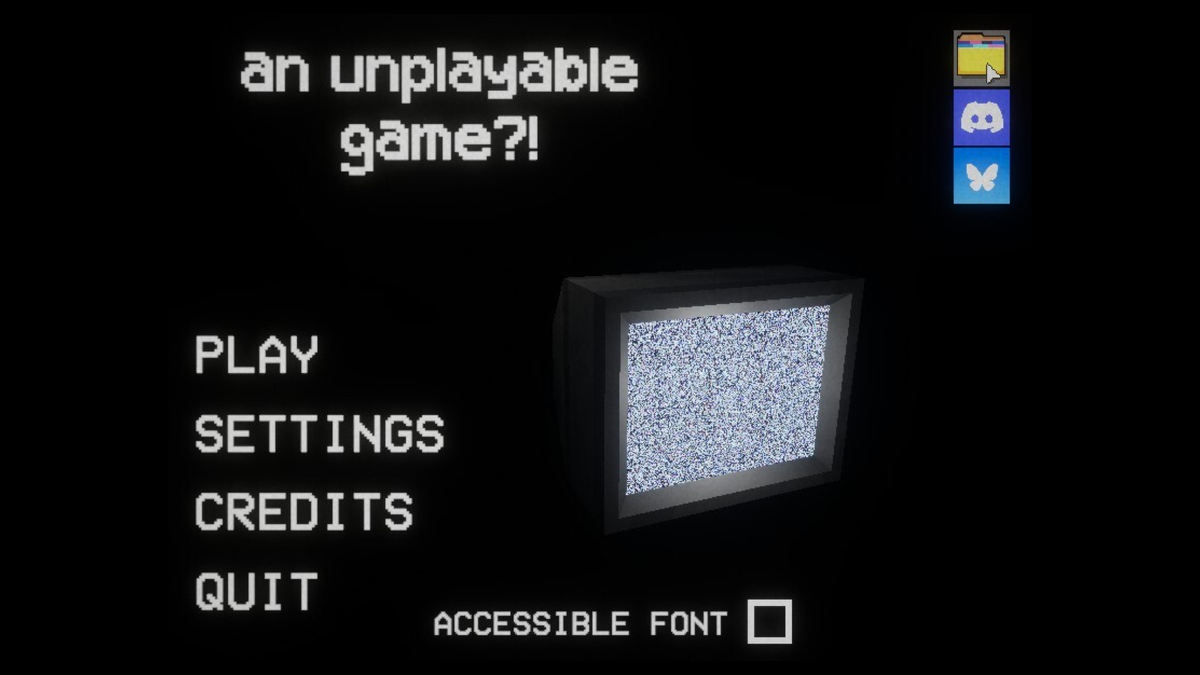
Tess: Welcome back to another developer spotlight! Today we have Ben, the solo developer behind “an unplayable game?!”, a game about accessibility settings! Literally. Ben, an unplayable game?! is extremely unique in that it forces players to turn on accessibility options and reckon with how important options like as timed input toggles can truly make or a break a game for a player. Where did the idea come from?
Ben: The concept originated directly from gamers being cruel and stupid — unsurprisingly. Specifically, back when Elden Ring first came out with it’s signature uncompromising difficulty, which led to tons of play issues, and discussions of "gameplay assistance vs. difficulty.”
We've all heard it: people saying that it takes away from their personal achievements if anyone anywhere beats the game with more forgiving gameplay. And that's dumb — I'll say that pretty directly, but it got me thinking about the topic and talking about it publicly, since I was a streamer at the time. I had the typical inflated ego and heightened sense of importance that comes with any amount of notoriety.
I was also going to college for game development at that time and was developing the perspective that games are for everyone. I don't want anyone to have issues playing my future games, and I don't want anyone to feel excluded from the experience just because of limitations outside of their control. That's not fair, and it's terribly disrespectful, but it's a design problem that can be solved with just a little effort and consideration throughout development. Hard games like Elden Ring with severely lacking accessibility considerations end up being horribly exclusionary to massive groups of players, instead focusing entirely on making this perfect adventure about overcoming insurmountable odds...which only works if you can play the game in the expected manner.
Artistically, I think that's pretty cool. The team at FromSoftware is so steadfast in ensuring the player can only have the intended experiences, the struggles, the triumphs, and those amazing feelings are why the games are so beloved. But as a person who cares about other people, I think it's absolutely horrific to create an experience that makes no effort to not exclude entire communities of players.
Unfortunately, being vocal about that online exposed me to some of the most cruel and closed-minded opinions on accessibility I've ever heard.
To give them the benefit of the doubt, I think a lot of the pushback comes from a lack of perspective, things like thinking that accessibility starts and ends with colorblindness filters, where people just don't know or understand different kinds of disability.
Still...not great, but a narrow worldview is better that outright cruelty, I think. The worst of it, though, comes from capital-G Gamers who actively oppose accessibility accommodations and try to invalidate the groups that need them, because they feel that the mere inclusion of those settings would somehow take away from their own personal achievements. I can't do anything about that. But the first group? I think they just need to understand that accessibility settings aren't there to make the game easier for people who can already play it, they're included to make it playable for people who otherwise wouldn't be able to play otherwise. To reach the same level of relative difficulty regardless of ability, so everyone has the opportunity to have the same experience.
Tess: I remember the Elden Ring difficulty vs. accessibility discussions back in 2022! The average gamer doesn’t understand that accessibility does not equal difficulty. An easier difficulty setting doesn’t solve accessibility issues — that’s not what disabled players are advocating for. We’re advocating for things like colorblindness filters, text resizing, greater controller adaptability, clearer highlights, and more. And you’re right: how does a colorblind option make the game easier? It’s an option.
You mentioned you were in college when you had a come-to-Jesus moment with accessibility in games. What experience did you have in that moment that inspired you to create a game about accessibility?
Ben: So, years after that, when I graduated into the worst job market in living memory, I found myself feeling pretty helpless. Getting into the games industry was completely out of the question as the positions I could realistically apply to were so in-demand that they got swarmed with people who were way overqualified, and any junior roles were rapidly getting cut or replaced by AI.
I went all-in on game development, taking freelance gigs for prototypes or building features for small games. But it wasn't particularly creatively fulfilling, and the shadow of generative AI was never far away, since I'd taken on too many gigs where I had to sift through and clean up AI-generated code (which is pure condensed tech debt, by the way).
Eventually, I turned to indie development in my spare time. After bouncing off a few prototypes and planning out concepts that just didn't seem fun, I finally circled back to the idea from years earlier: that much of the pushback around accessibility, both in design spaces and broader gamer discourse, comes from a lack of perspective and understanding. I realized I could make a game about that. A game where players experience firsthand how accessibility accommodations make games playable.
That's kind of all it was: a better way to get the point across than an essay, a blog post, or a video ever could.
Tess: We’ve seen a lot of accessibility features being replaced by AI, like closed captioning. The problem with using AI to replace the work actual captioners do is that it often produces poor quality work. AI isn’t able to interpret what’s happening on-screen or reliably infer the tone of a scene. It’s notorious for getting words or phrases completely wrong, especially when translating from another language. It’s not a good solution, and actively creates more debt, like the tech debt you mentioned – because someone has to spend time undoing its mistakes.
Using that example, can you tell us more about the accessibility features in an unplayable game?! and how you approached gamifying accessibility to make it fun to play?
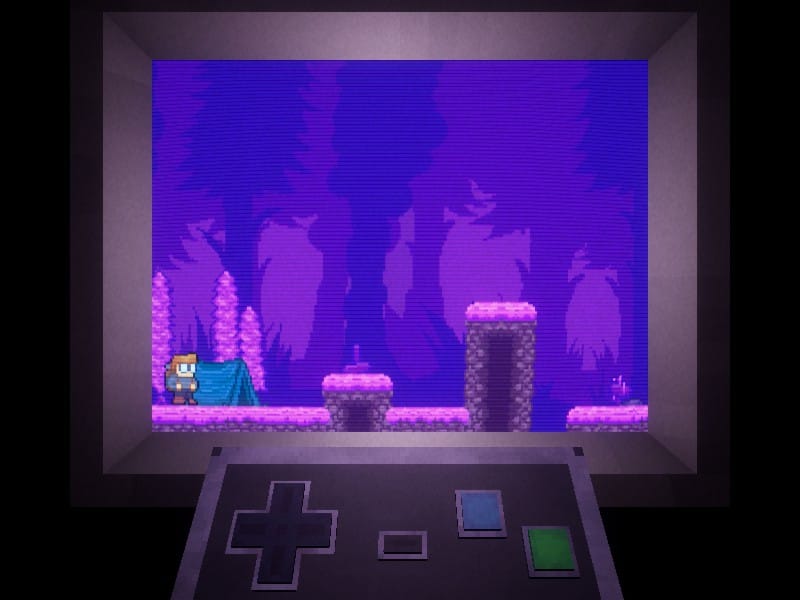
Ben: At its core, the game is a platformer with a weird control scheme, so weird that it creates severe barriers to playability in such a timing-based genre. Without spoiling too much, the game includes accessibility options that make it playable by alleviating timing pressure and making inputs easier. That's the game-within-the-game: a platformer where the accessibility options are the entire point.
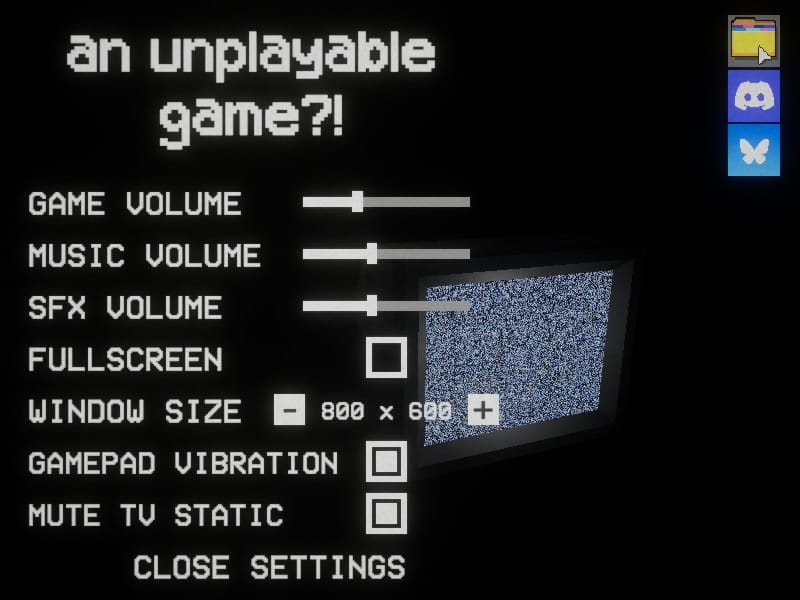
an unplayable game?! as a whole includes real accessibility options beyond that, to address concerns and issues players have identified (because, y’know, I want my game to be playable for as many people as possible!) There's an alternate font toggle that uses Atkinson Hyperlegible, a font designed for improved readability. There are separate audio sliders for everything in the game that even go up to 200% volume, as well as a controller vibration toggle, since I went a little overboard and the vibration can be a bit overstimulating.
The most important option, in my opinion, is the ability to mute the TV static at the main menu. It's a repetitive noise that can trigger misophonia for people with sensitivity to those kinds of sounds. I've heard that the static can be so intense that some players have to rip their headphones off as soon as they reach the main menu. Because of that, I didn’t just add a toggle to mute it: I give that option before the main menu even opens for the first time. I'm especially proud of that; it feels good to accommodate people and improve my game.
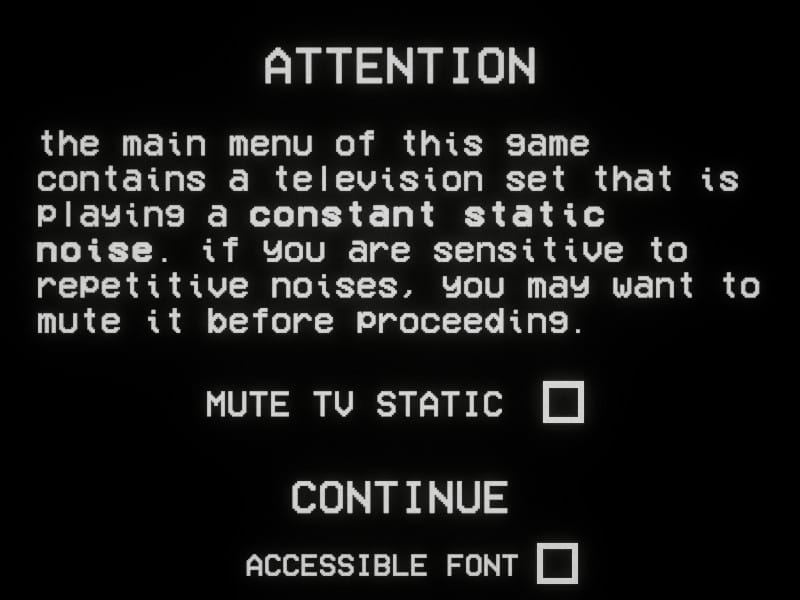
There's also accessibility considerations beyond the settings menu, like high-contrast colors, colors having no bearing on gameplay, mouse-only controls, large text, subtitles for spoken audio, and distinct hover, click, and release sounds for everything in the game.
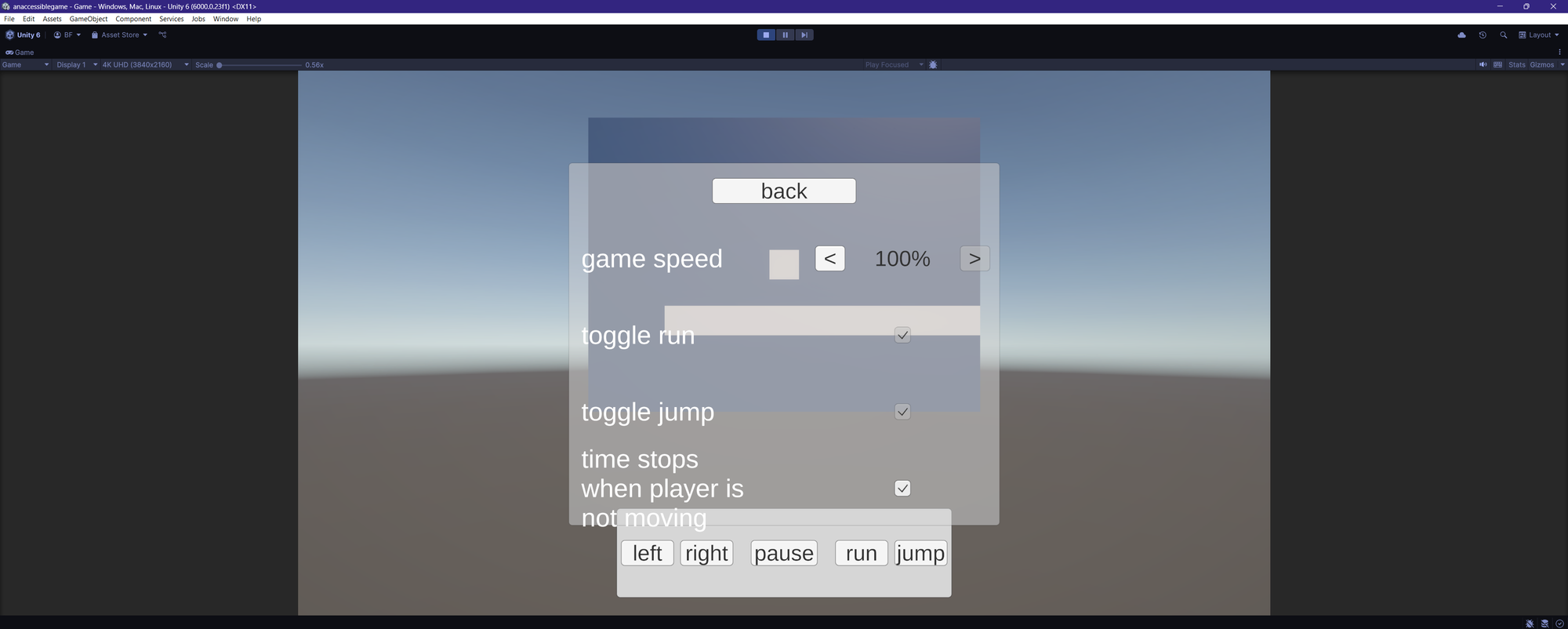
On the more spoiler-y side, the game is controlled through an on-screen controller. The platformer includes settings to reduce the game speed to widen timing windows, options to turn on all controller buttons into toggles so multiple inputs can be used simultaneously, and, most importantly, a setting that pauses the game’s physics whenever you’re not moving. This completely removes timing and dexterity requirements from a genre that is notoriously all about timing and dexterity!
But to touch on the topic of AI (kind of. More like the lack of it, honestly), I actually had to cut a feature specifically because I refused to use it. I'm really proud of the fact that the game was made completely without generative AI assistance or output, just human effort and ingenuity. But just because I didn't use it doesn't mean AI didn't harm the project.
It really sucks how much AI enables dishonest people. You can't even ask for help online anymore; it's terrible. But back on topic, I kind of hit a wall with localization. I only speak English, so I can't translate the game myself. Obviously, Google Translate and similar tools exist, but they lose a lot when it comes to tone, and they often spit out translations so bad that the meaning can be completely lost. In my opinion, that's worse, and more disrespectful, than not doing localization at all.
But trusting someone from the internet was also off the table. We've already seen high-profile cases of games using garbage AI translations, and I've seen too many devs unknowingly received AI-generated assets. I do not want my game to be screwed over by some rando not disclosing AI usage. At the end of the day, I can't verify any of the translated text because I don't speak the language.
And that's one of my biggest regrets with an otherwise finished game. I think the message is important enough that it shouldn't be limited to English speakers, but verifying translations just wasn't in the cards with my budget of nothing.
What is interesting, though, is that the infrastructure to support localization is already there if I'm ever able to make it happen. I wrote all the current in-game captions myself and set up the text objects to accept alternate text for different languages; I just never had any alternate text to put in. So it's not off the table forever.
Tess: Y'know, I think that still shows ingenuity and commitment, even it it's not something you're able to do right now. You still thought about it and created a framework for it, should it be possible one day. And Ben – games are an art form. A painting is rarely finished in one go. The artist has to step back, collect inspiration from elsewhere, sometimes not think about it for awhile – for months or even years – then come back to it later.
Maybe that's your game. Localization can be the painting you return to later. How we write, create words, use language, and communicate ideas is accessibility. Localization is accessibility, even if it's not possible to complete right now.
Now, what happens if a player chooses not to engage with the accessibility settings at all – not even toggling a single option?
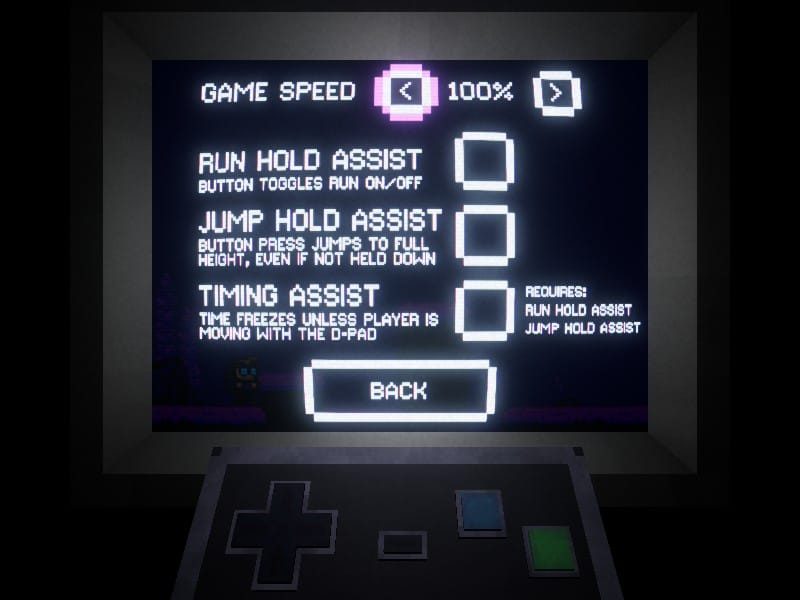
Ben: Without the accessibility settings, it's simply not possible to beat the game. People have certainly tried, though! Flicking the mouse from button to button can get you past a few jumps, but you're ultimately limited by only being able to click one button at a time. You can gain a surprising amount of height by holding jump and then holding right on the on-screen controller’s D-pad, and that will get you past the first two early jumps, and it’s frustrating, but it is possible.
After that, however, you’re faced with a very simple long jump that requires you to jump at maximum height while moving to the right at the same time in order to clear it. I designed this section to be clearly impossible, so even if players make it that far, they can tell it’s just not going to happen. Hopefully, by that point, they're frustrated and annoyed at how unplayable the game feels. That’s when they start clicking the other buttons on the controller in search of answers, find the accessibility menu, and everything clicks.
It's been really cool to watch Let's Plays where, after that moment, the player starts smiling, calling the game clever, and actually having fun after spending the last five minutes playing what essentially amounts to a rage game.
Tess: “What amounts to a rage game.” Hah! You’re intentionally ragebaiting the audience! I love that. What was the development process like as a solo developer? Did an unplayable game?! go through several iterations, or was the end goal immediately clear — that is, ragebaiting gamers.
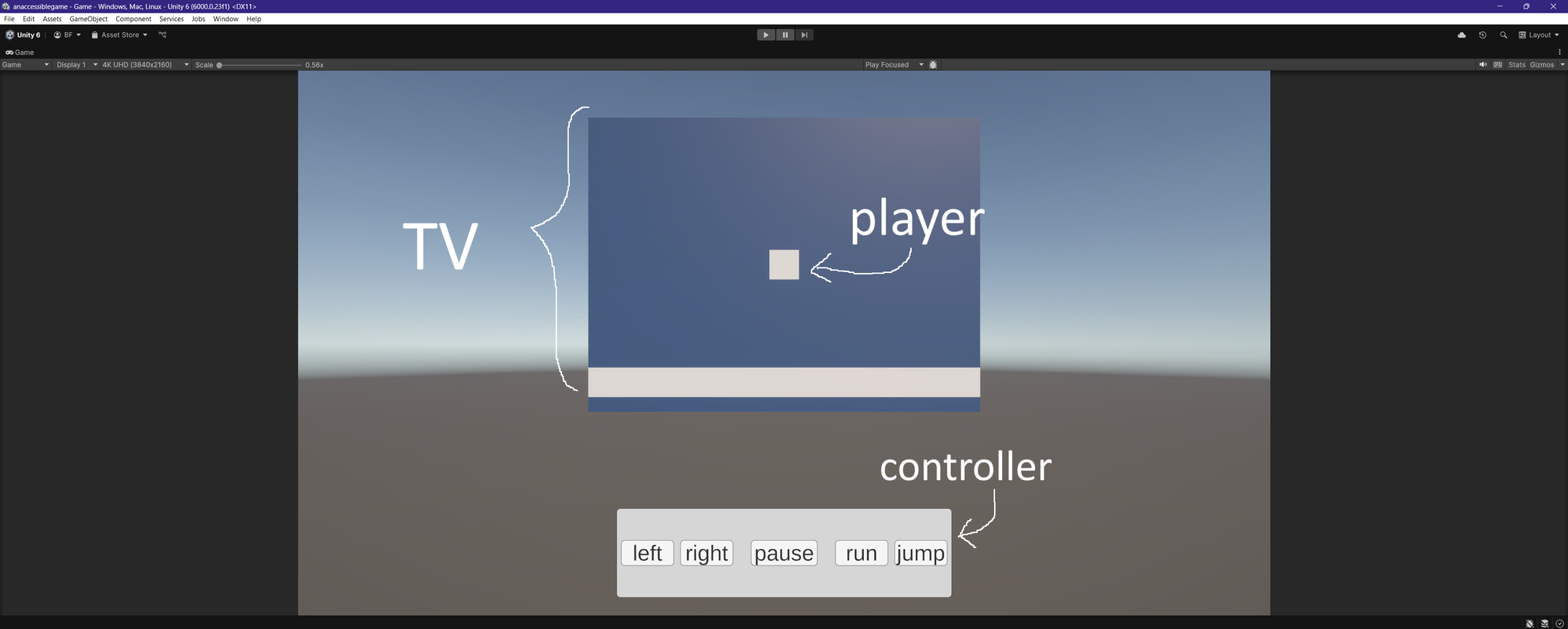
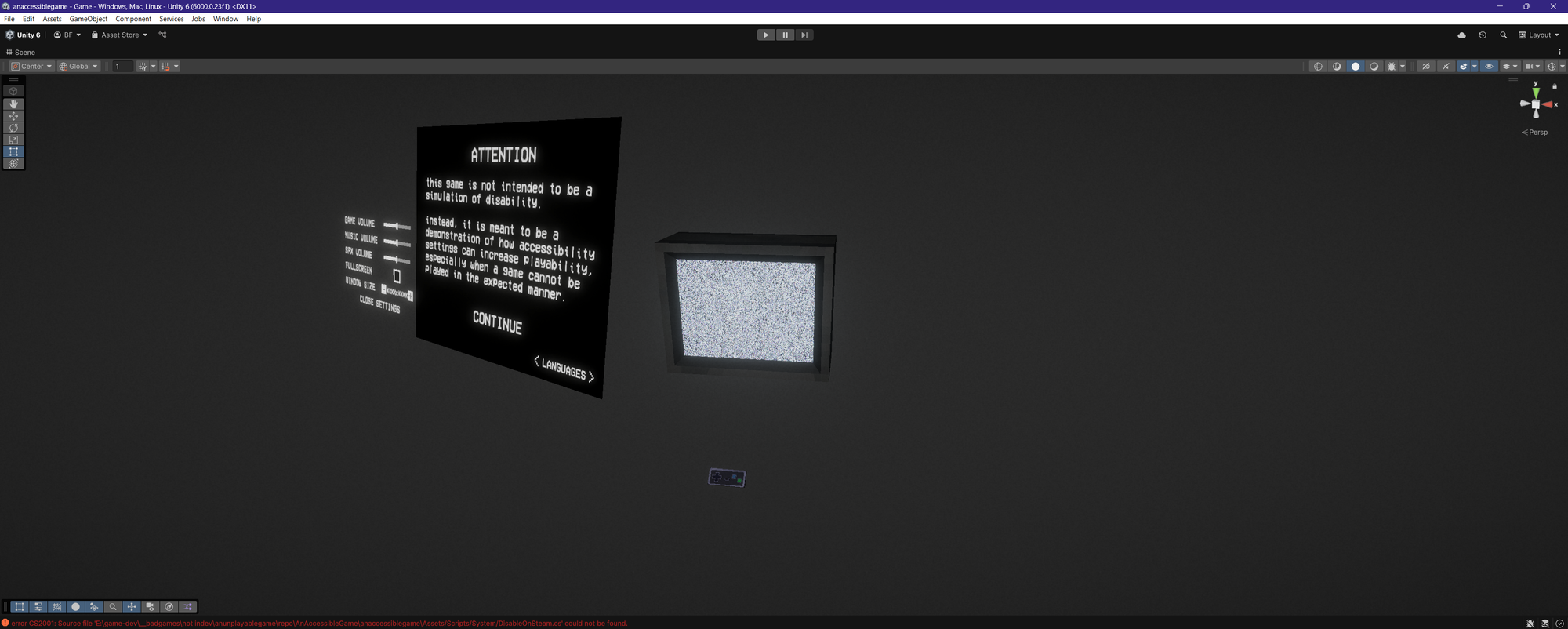
Ben: Honestly, the gameplay concept was pretty clear from the start. I didn't change much from the original idea: the game required a simple control scheme, which informed the basic retro controller, and that naturally led to the lo-fi CRT/VHS aesthetic. That said, it was only possible because it was an extremely simple game born from a very straightforward idea — that is not how games typically develop. But I wanted to start small, keep the scope manageable, and it just kinda worked out.
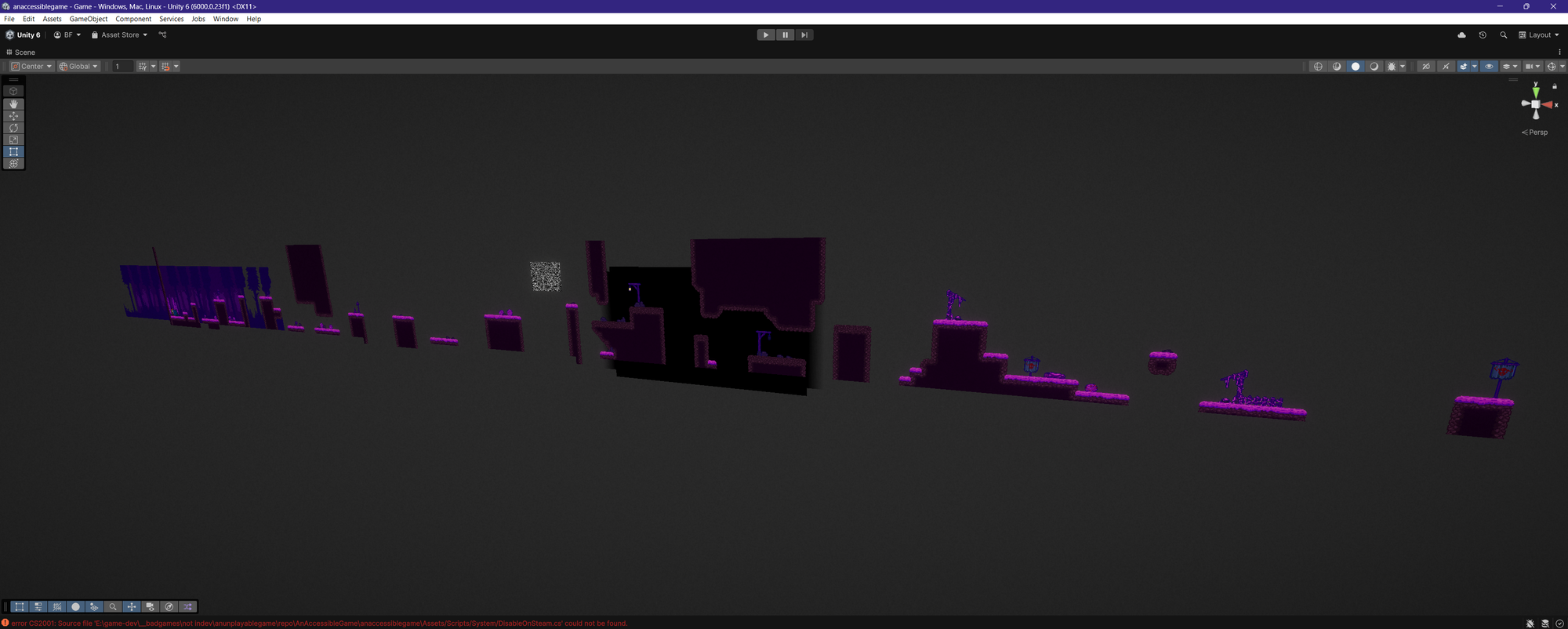
The biggest addition ended up being the developer commentary, scattered throughout the game as clickable nodes. I added this in response to the deluge of AI-generated "art" that was being pushed out last year: images, videos, voice acting, games, websites, and unfortunately much more. In a time where AI was (and still is) taking so much from us artistically, both in terms of plagiarism and through diminishing the perceived value of art, I felt that it was important to highlight the human side of game development. I wanted to be extremely transparent about the struggles, the time investment, and all the small decisions that into making an unplayable game?!.
That is art. That's human artistry, and it feels more important than ever to talk openly about the effort behind creative work. Games aren’t just products; they’re the culmination of countless hours of labor, created for specific reasons.
Sometimes it’s because they’re fun to make. Other times it’s to give you, the player, a memorable experience. And sometimes, yes, it’s because games are one of the most expensive forms of media to produce and shareholders want a return on investment. Thinking about those motivations is part of engaging with art, and discussing the human artistry in my game is my way of encouraging that engagement.
People don’t often talk about the creative process, because games tend to sell better when they’re presented as perfectly polished products. But right now, I think human artistry matters far more than perfect presentation.
The game definitely has issues; it’s architected pretty poorly behind the scenes, and the sound effects are rough with lots of background noise if you play them at high volume. But I learned a lot from the process, and I’m absolutely not making the same mistakes in my next game. It taught me to plan better and actually apply those “good software engineering practices” I learned in college, and turns out they really do make life easier.
Tess: Speaking of art and being recognized for your artistry – congratulations on your nomination for Excellence in Accessibility Design for the Games Accessibility Conference Awards! How do you feel about it? How can we support you?
Ben: The award nomination is... wild. I was hoping the game would eventually hit 10 reviews total so it could show up in Steam’s discovery queues, but instead it's been played, reposted, and showcased by so many people I look up to and deeply respect. I guess it found the right people, who shared it with the right people, all the way up the chain until it led to a nomination. This is my first game release after graduating college, the first game made under ./badgames.zip, and it's fifteen minutes long. At this point, I've accepted that I have no idea whats going on or how any of this happened.
There are thousands of games that deserve to be incredibly popular, but will never even receive the fraction of recognition my game has. It’s all luck — the internet is luck, content creation is luck — and I got lucky. I know that. I don't know if I'll ever feel like I deserved the nomination, but seeing how the game has resonated with so many people and genuinely expanded perspectives has made me incredibly grateful that I got lucky this time. I hope my little game can do some good out there.
Unfortunately, the public voting for the award ended back in 2025, but I wouldn't want to influence that anyways. As for supporting me elsewhere, it's always appreciated when people follow my developer pages on Steam or itch.io. More followers means my games get emailed to more people, which creates more chances for someone to find a game interesting, give it a try, leave a review, and share it around. That's what helps games grow and reach more players!
I've also got a Patreon and a Ko-Fi, where I post lots of exclusive content and offer early access to games. Ultimately, though, those platforms exist to (hopefully) let me spend fewer hours on freelance work and more time on indie development. That’s the dream, at least.
Tess: Being a short game about accessibility, what do you hope players take away from an unplayable game?!?
Ben: I really hope that after playing an unplayable game?!, people walk away with a newfound sense of empathy and understanding. It's made for players and developers who never think about accessibility settings, and I hope it helps them understand why accessibility is so important. It's hard to really get how a game can be unplayable unless you experience it firsthand, but this game puts you in those shoes and forces you to confront it. I hope the game, and the experience, stick in peoples minds during every design choice and every conversation about playability. I think that'll make the world a little kinder, in a small way.
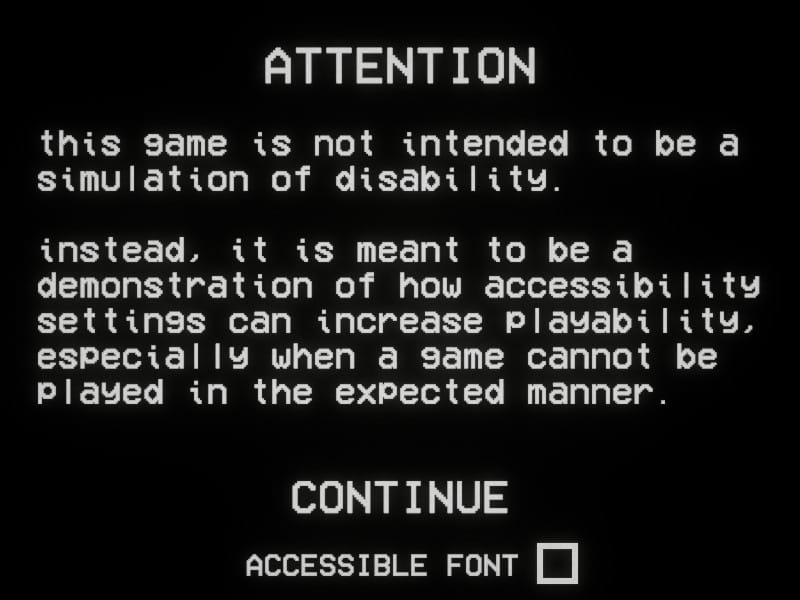
That's also why it's free! I want people to give it a chance, play it, and hopefully take something away from it. The more people who broaden their perspectives, the better.
Tess: For what it’s worth, it’s hard not to see why an unplayable game?! was nominated for the Excellence in Accessibility Design award! an unplayable game?! is both a game and lesson in accessibility education. It’s a great reference for developers who struggle to understand why accessibility matters. Someone at Ubisoft, Sony, Xbox, or elsewhere could put this in front of obstinate co-worker, have them play it for fifteen minutes, and watch them confront the inaccessibility firsthand. It’s impossible to come away from that experience still advocating against accessibility.
So, what’s next for an unplayable game?! Are there additional updates planned?
Ben: What's next...other games, I guess. I'm always open to fixing bugs or updating accessibility accommodations if anyone has any issues with playability, but I've got no additional content planned for an unplayable game?!. I definitely want to revisit the gameplay concept later. I have a whole design document for a puzzle platformer with tons of time manipulation mechanics, building off of the timing assist from this first game. But that's a bit too big of a project for me right now, and I want to make sure I get it right, so I'm working through my backlog of smaller game ideas. I'm keeping my projects limited in scope for now, but they’ll gradually grow until I can comfortably tackle my biggest ideas in a reasonable amount of time. Eventually (probably), I'll make a full platformer about time manipulation.
It's a little scary to go from such a personally meaningful project to smaller games that let me practice polish, game feel, and fun. But I know it'll make me a better developer, so I'm happy to stay the course. I'm still really glad my first game had such an impact on so many people. That's more than I could have hoped for!
Tess: For a first game, you hit a home-run! That deserves praise and recognition. Your story resonated with the games accessibility community, which is a feat in itself! I can only speak for myself, but I’m excited to see what you do next, even if it ends up being something entirely different from the puzzle platformer you mentioned.
Thank you so much for joining me today and sharing your story about the development and the creation of an unplayable game?!. I had a lot of fun playing it, even at the beginning when I was struggling to make it over the first jump. I spent so much time toggling different buttons in the Settings menu until I finally got over it!
Join the conversation!
Looking for an inclusive community of gamers who love accessibility? Join our Discord! Meet the team behind AbleToPlay, chat about accessible games, and even learn what goes into making games as accessible as possible.